The development of game technologies is taking huge step forwards and is sometimes outperforming product development tools such as CAD, simulation etc. It is very interesting to see how game software has new capabilities that allows you to visualize, simulate and create stuff that belongs to the game space; but when you take a closer look, it seems to be much than a release of commercial design software (such as CAD, etc.)
Recently, I’ve been looking at virtual environments that are becoming more and more popular, in my opinion. The first well known one is Second Life developed by Linden Lab. But recently, I have seen few new environments. One of them was developed by a company – Metaplace
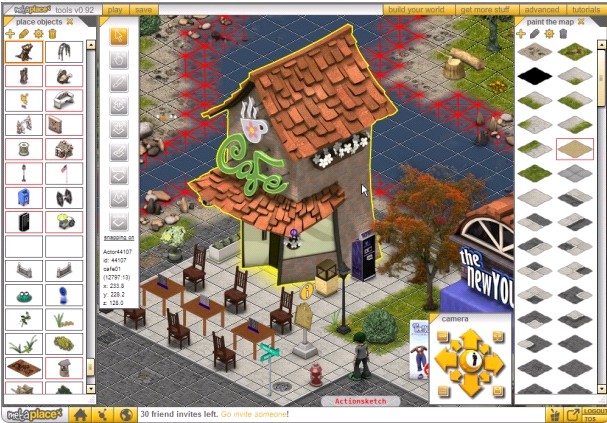
What is interesting about this software is that it is very similar to blog-following software, as it works inside of a browser.
From the customer ‘s standpoint, this functionality is very useful in scenarios relating to collaborative design and social experience. What if PLM companies were to use these capabilities to develop design software that would run or integrate with these virtual worlds? Design would therefore become social. Another possibility would be to integrate collaboration capabilities that allow you see social groups and other contractual work in this virtual environment.



Oleg,
This is a very good question that has been showing up a lot lately.
First, its good to think of virtual worlds not as games but as platforms… platforms for social media, games, training, or any number of things.
Is it a platform that might provide value to the PLM world eventually? I certainly think so. Seeing a part or assembly in a CAD window is not the same as interacting with it in real world environment. Virtual worlds provide the middle ground here.
Mark
Mark,
Thanks for joining discussion! Very good point. To see such stuff as platform is right way in my view. But there are two main trends – CAD companies going this direction (from their ability to design and build in 3D) and Games manufacturers (from their ability to create virtual environment for games). There are some mixes – i.e. Virtools as part of DS.
Regards
Oleg
I think you would have to use the word “game” very loosely. Certainly World of Warcraft is a game but most would say Second Life and its open source cousin, OpenSim, are not games.
Still, I see your point. “entertainment” and “business” trends exist, but like you said, “there are some mixes” – more and more everyday.
Mark
Mark,
One comment with regards to trends. I see major technological trend- expensive technologies becomes affordable and we can leverage them in everyday life. But sometime technology is going bottom up too. This is what happens in Game technology. Because of user’s adoption it becomes important for business. So, in this example, I see CAD/PLM and Game business definitely are going to cross their offerings.
Oleg
[...] 27, 2011 · View Comments Almost two years ago, I published the following post – Virtual World: Where is the boarder between game and PLM software? Gaming technology is developing very fast. Today’s games open lots of opportunities to [...]
[...] Games and Product Development Almost two years ago, I published the following post – Virtual World: Where is the boarder between game and PLM software? Gaming technology is developing very fast. Today’s games open lots of opportunities to [...]
[...] on September 19, 2011 · View Comments It is already more than 2 years I first asked on my blog if there is a border between games and PLM software. For some of the people back that days it was [...]
[...] is already more than 2 years I first asked on my blog if there is a border between games and PLM software. For some of the people back that days it was [...]